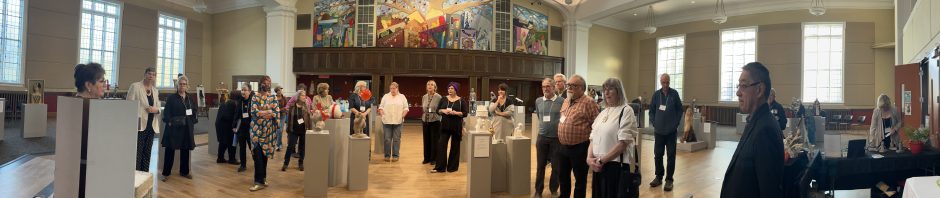
Artist of the Month – Terry Schaub, Stone Sculptor

by Sandra Marshall

A most important aspect for Terry is that his sculpture tell a story – to inspire, to captivate, and draw people in – to ask questions. He wants the work to have an intention and a feeling and hopefully elicit a response.  A great example of that is when he noticed a young boy stick out his tongue in response to the outstretched tongue of a sculpture. He loves that his works raise a reaction from the viewer.

The love for the work was soon recognized by galleries and collectors. In 2006 he had his first show. Since that time he has been in multiple galleries and has seen his pieces bought by collectors from around the globe. In 2011 his piece, “It’s The Little Things”, was presented at the United Nations Convention on Biological Diversity and now resides in their Museum of Nature and Culture in Montreal. The next year,  he was commissioned by CFB Trenton to commemorate the return of a WW2 bomber to its home base. The stone sculpture which was presented to HRH Prince Edward for his private collection.
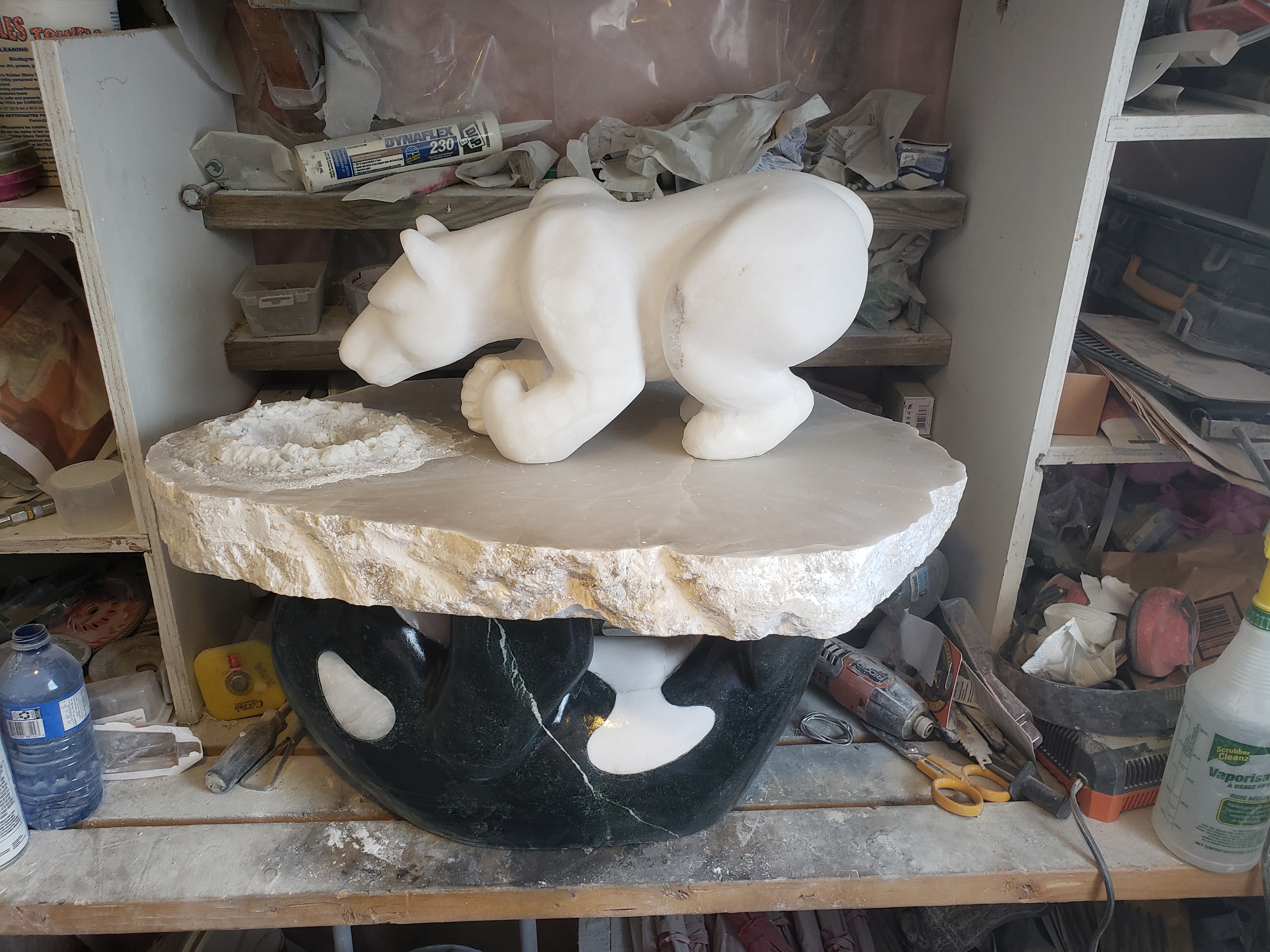
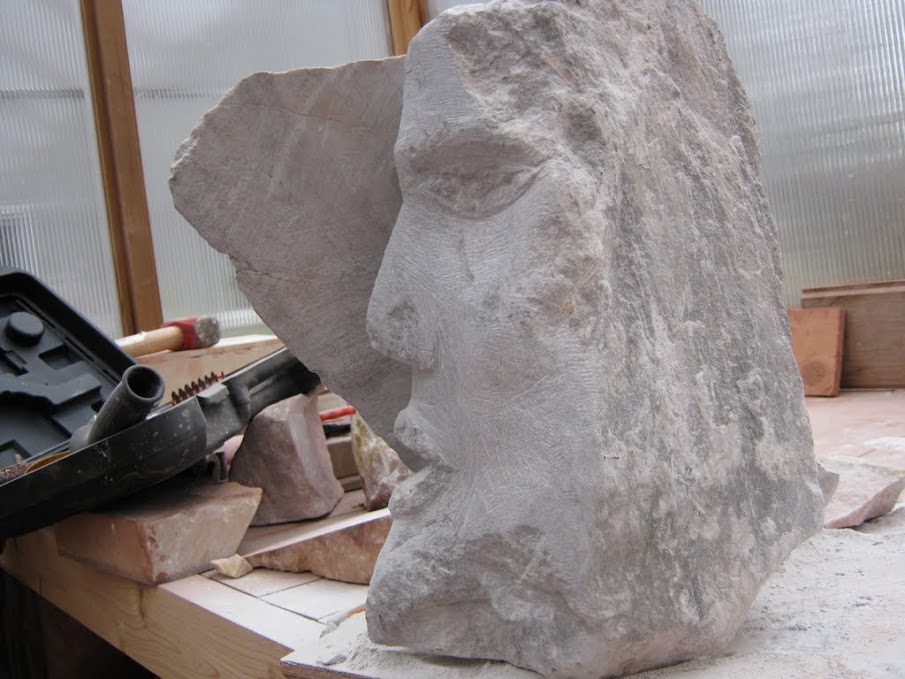
Terry started buying rough stone from Ottawa suppliers and then built himself a studio, attached to his home. In time he started importing stone from different countries. He warehouses a large quantity of rocks from which he selects the one which most speaks to him through its veining, incidental colours, form and size. He might sketch some ideas on paper and sometimes, to get the creative juices flowing, he may mark the stone with a sinuous line to set his cutting direction. Making bigger pieces is a challenge that makes him happy. For the crouching-bear-and-orca piece that he is working on now, the ice slab alone weighs 80 pounds.
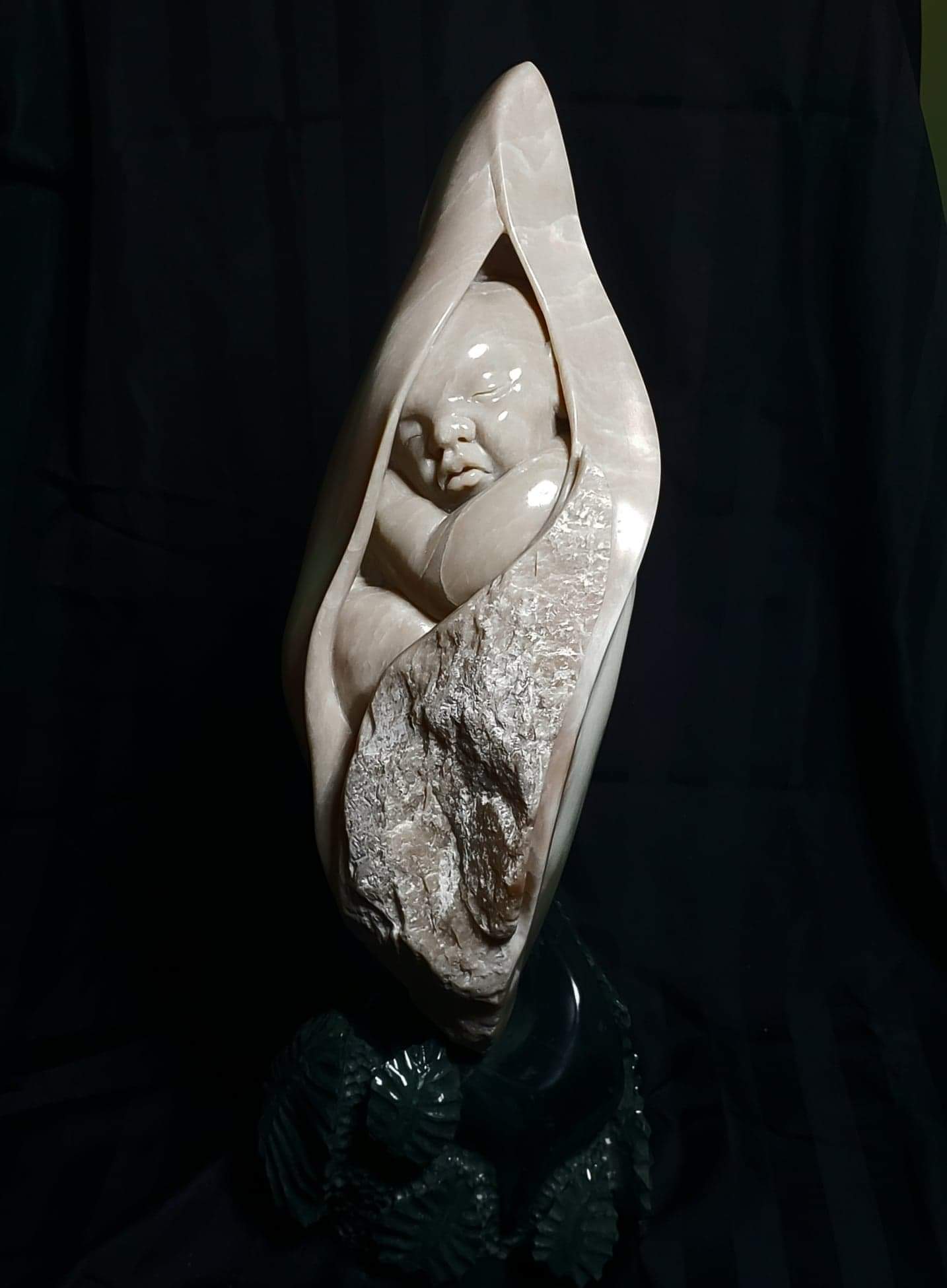
In 2019 at age 52, Schaub required major surgery for metastasized cancer. He spent the next day, his 53rd birthday, in a hospital bed wondering if he was going to live. He credits his wife, Kelly, for the fact that he did survive. Recovery was long and hard. It was another turning point for his life and his art.

Though he was putting almost full-time hours into the art at that point, he decided to leave 3M  and make art his sole focus.

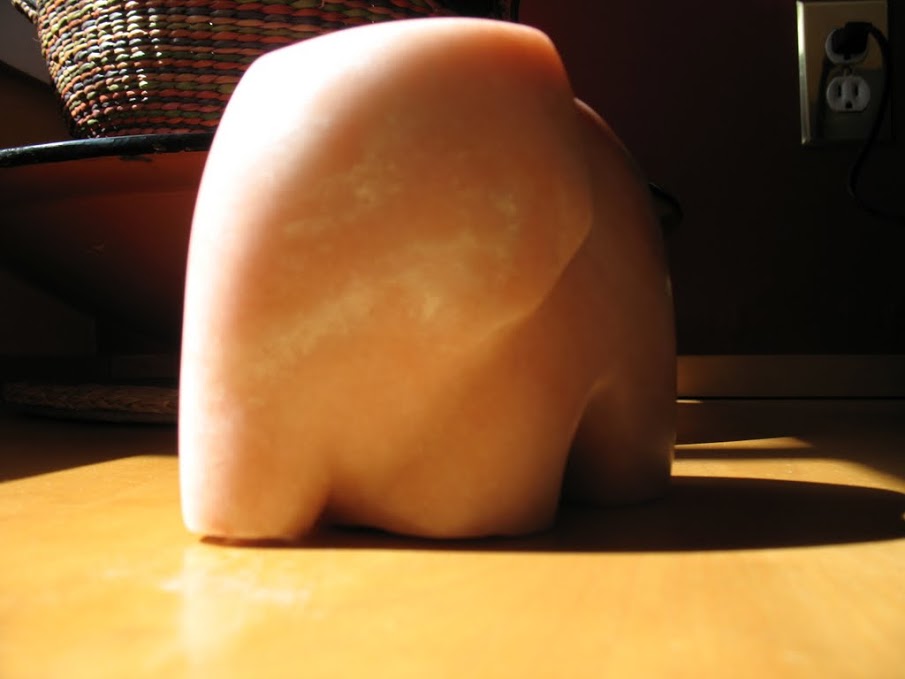
Each stone has unique qualities: East Indian soapstone has an incredible variety of colour.  The harder stones such as alabaster, chlorite and fluorite are more challenging to carve. All of the stones take a commitment of time. The harder the stone, the more intricate the carving, the more time it takes to complete the piece. Once the rock is chosen, the hard work begins. He studies it for its shape, balance, contours, holes and other features.

Terry Schaub feels at peace when he is carving. He might work from early morning without breakfast and rarely stops for breaks. One day he was in that flow and remembers when his wife came to knock on the door and asked him if he had finished yet. He thought that it was almost suppertime. She surprised him by saying ‘’No, its midnight.’’
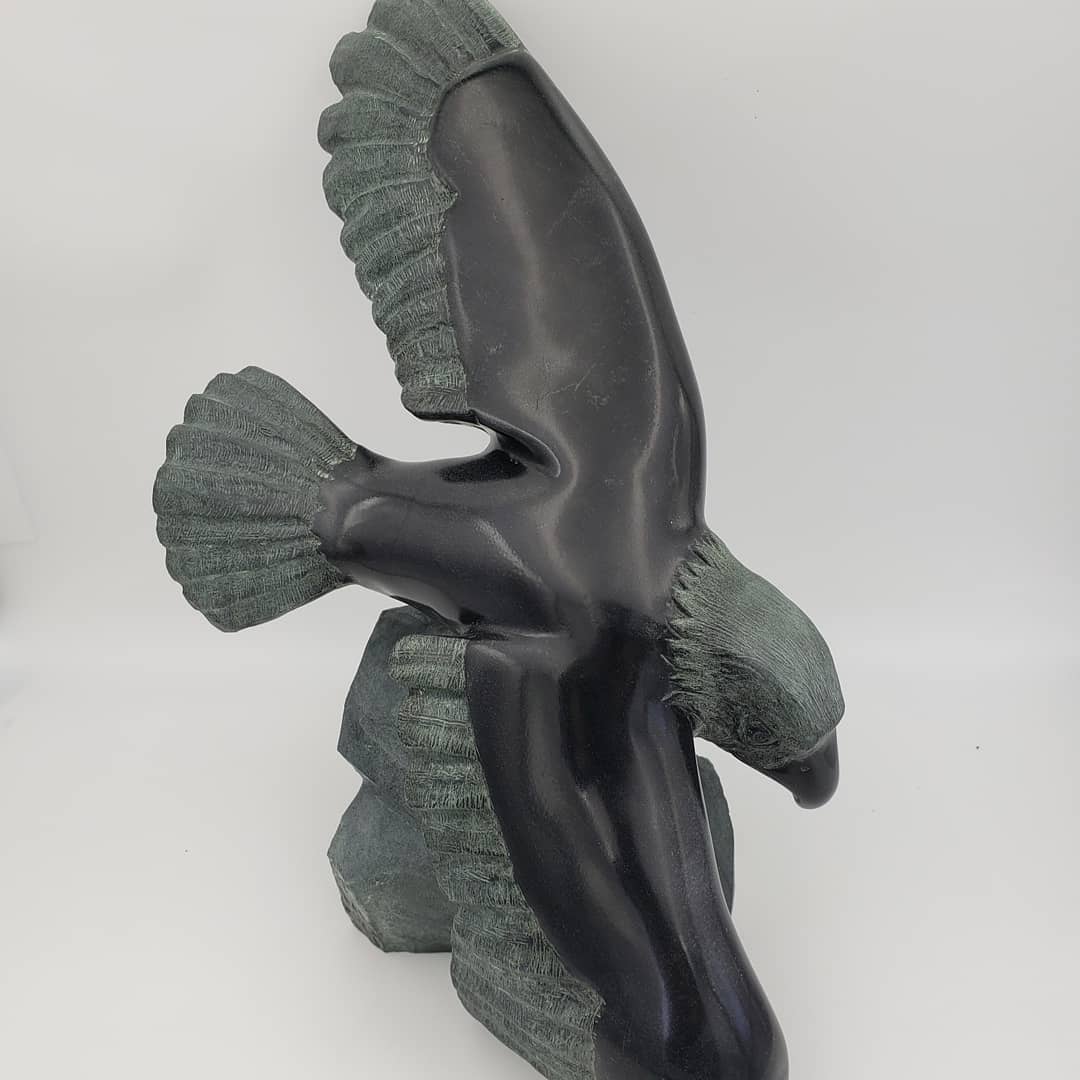
Rough shaping begins with reciprocating saws and a large angle grinder with an 8 inch diamond blade. Then he might use an electric Foredom tool, for which he estimates he has about 200 bits, and shaped files called rifflers for smaller details. Then a marathon of sanding starts- often more than a week to work through different coarseness of sandpaper from #200, #300, #400 grit to the finest #2000 as he smooths the surfaces. It has taken him time to appreciate the long periods of sanding. The small changes made by each higher grit becomes a lesson in patience and a time for reflection. Then he reaches the magic time when the sheen appears on his sculpture.  Polishing brings out the colours and veining. He adds beeswax, tung or linseed oil, clear coat lacquer or rendered fat to give the work a sheen and bring out the rich colours that the rock previously lay hidden.
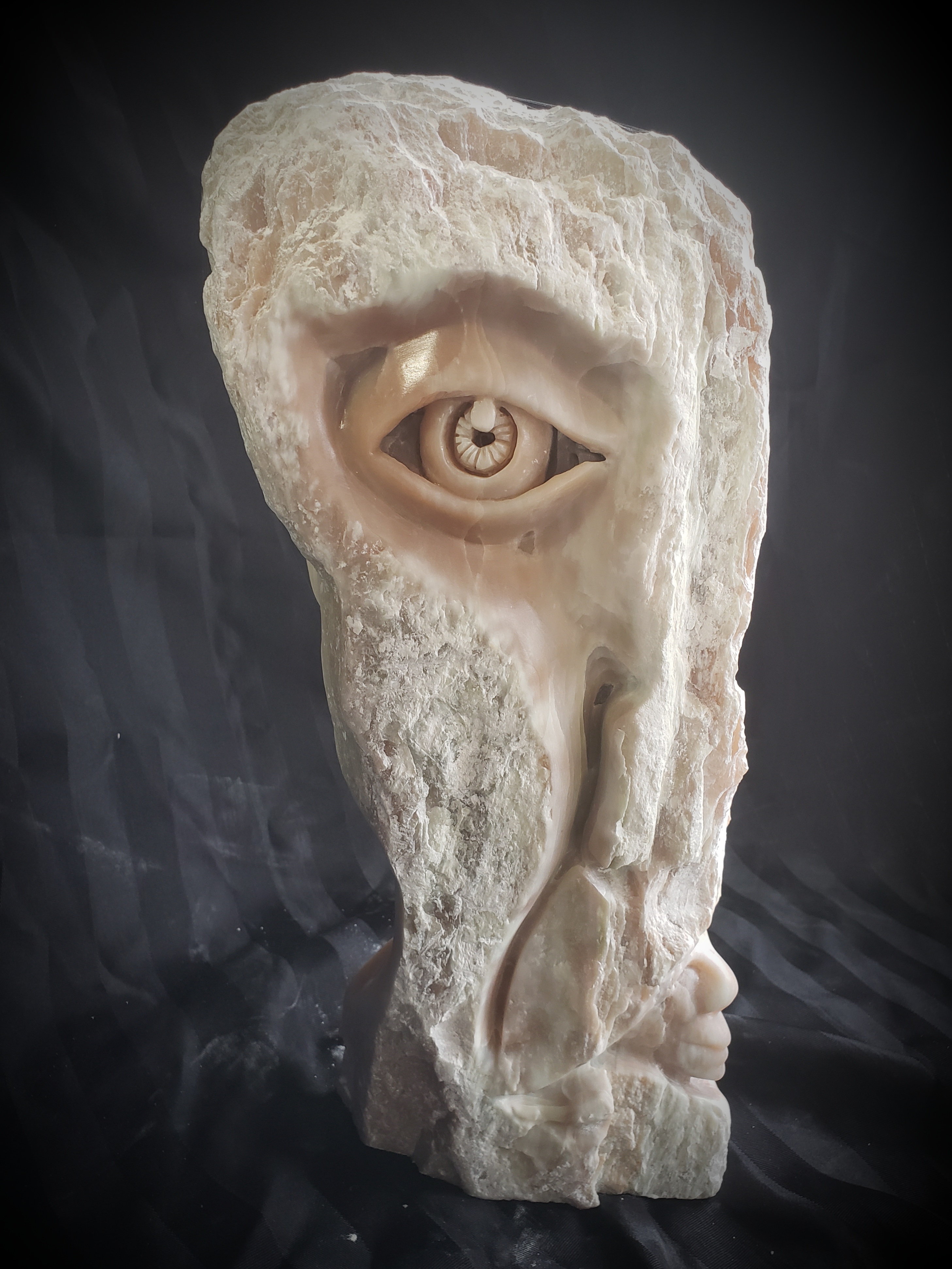
Terry has exhibited his work in at NCNS show in the Museum of Nature many other galleries such as OWAA , Shenkman Art Center, Gallery on the Lake, Remington Art Museum in NY,  O’Connor Gallery, Gallery 6, NAK’s Ottawa Gallery and Patrick John Mills.

As most artists know, Covid stalled everything. People were not spending on art, so it is now a time to reboot with new works.

Terry suggests that, to a newcomer to this art, education and experience are not necessary to start the journey, but the love to create is essential. Persistance is required!

For more of Terry’s work visit:

www.twchaub.com

https://www.facebook.com/terry.schaub.37

Posted in art classes, Art Shows, Art Workshops, Artist of the Month, Canadian Stone Carving Festival, clay artists, clay sculpture, Exhibition Opportunities, Member Event, Member Profiles, Network Show, Online Art Gallery, sculpting workshops, Sculpture events, sculpture show, Stone Carver, stone carving, stone sculpture, The national capital network of sculptors | Tagged , , , , , , , , , , | Leave a comment

Artist of the Month – Eiko Emori – The Magic of Glass

by Sandra Marshall

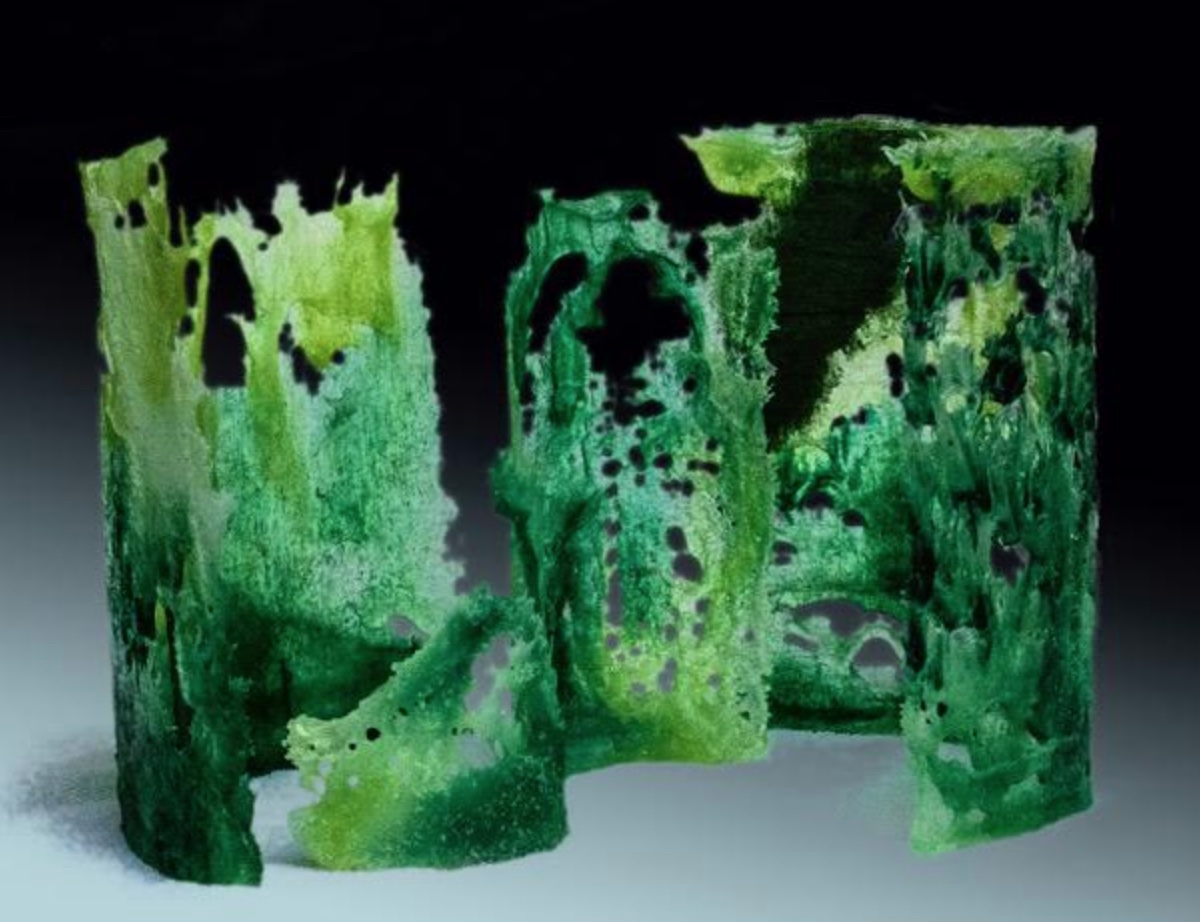
Eiko Emori’s glass sculptures are based on a unique craft called pâte de verre, in which grains of glass are heated together in a high-temperature plaster mould to fuse them.

She was first attracted to glassmaking when admiring the colourful work of French artist, Émile Gallé, whose factory produced remarkable examples of Art Nouveau, and she wanted to learn more about glass work.

Japanese born Eiko earned a Masters degree of Fine Arts at Yale University and a Diploma in Design at the London Central School of Arts & Crafts. She also studied in France at Académie Grand Chaumière and worked as a graphic designer in Tokyo, New York and Toronto. She came to Canada in her mid-twenties, settling at first in Toronto and finally in Ottawa. Eiko’s graphic design expertise is in book design, including type and typography.

In the 1990s, she returned to Tokyo to support her mother. At that time, the glassmaking craft was located in a ward of Tokyo and Eiko took advantage of the opportunity to learn more about these arts. Following classes offered at a glass factory, she became enamoured of the pâte de verre process. When she returned to Canada, she carried on with this interest, refining her skills.

As member of the Royal Canadian Academy of Arts, and Graphic Designers of Canada, Eiko continued in her graphic design business in Ottawa. She also began to develop her skills in working with glass, a process totally different from print media, in which the final product closely resembles the final sketch. She explains that working with pâte de verre is a collaborative process between the artist and the glass. In 2021, Eiko’s work was recognized by the Pattie Walker Memorial Award for excellence in architectural glass from Crafts Ontario and has also received an Ontario Arts Council Individual Craft Project Grant.

Glassmaking originated in the Middle East where artisans would gather sand from the desert and fuse the silica particles in hot wood fires. Unlike glassblowing, pâte de verre is a process of glassmaking that has relatively few established rules and examples. As a result, Eiko’s work continues to evolve, as she tries different approaches.

Movement in Blue Green – 41 x 33 x 8cm

Eiko describes the first part of the pâte de verre process as similar to the labour intensive preparation for bronze sculpture. First she makes a wax sculptural form. She then prepares a high-temperature plaster using a recipe that she developed through many iterations. The mould must be strong enough to tolerate the high temperatures needed to melt the glass.

The next step, the plaster removal process, is very tedious. Even with the help of electricity and a computerized thermostat, pâte de verre is still very time-consuming and cumbersome. She is not surprised that the technique was completely abandoned for two thousand years until it was revived in the early 1900s in France. However, Eiko is excited to see the piece emerge from its hard cocoon in the last stage. She sees glass as her partner and is happiest to see the piece emerge more beautiful than expected.

Eiko was trained in seeing as a child by a well-known painter, Takuji Nakamura, father of a classmate. He was a strict teacher, and encouraged his pupils to keep on drawing. She continued drawing throughout her formal art education. Eiko reminds students who wish to take up visual art that basic training in seeing is essential. Keep practicing, as this develops the critical hand/eye coordination of a skilled artist.

Eiko’s work is shown at the Foyer Gallery and Craft Boston. You can also see more of her work online at http://www.designerglassstudio.ca. These images are examples that show Eiko’s unique work. They are the results of her experiments in varying the method of plaster investing and temperature control of the kiln.

During this process she carries on a conversation with the glass inside the kiln.

Little Woods – 33 x 46 x 33cm

Posted in art classes, Art Shows, Art Workshops, Artist of the Month, Canadian Stone Carving Festival, ceramic, Ceramic Sculpture, clay artists, clay sculpture, Exhibition Opportunities, glass sculpture, learn how to sculpt, Member Event, Member Profiles, Metal Art, Miscellaneous, Network Show, Online Art Gallery, polymer clay, sculpting workshops, Sculpture Atelier, Sculpture events, sculpture show, Stone Carver, stone carving, stone sculpture, The Boys and Girls Club of Ottawa, The national capital network of sculptors | Tagged , , , , , , | Leave a comment

Celebrating Rosemary Breault-Landry

Read the story of Rosemary’s bronze sculpture of Canada’s first indigenous Senator, James Gladstone “The Gentle Persuader”. He was a lifelong advocate for Indigenous rights and he helped secure the vote for his people. Congratulations Rosemary on this wonderful recognition!

Read the full story in the Senate of Canada newspaper at:

https://sencanada.ca/en/sencaplus/how-why/meet-the-sculptor-who-memorialized-the-senates-gentle-persuader/?fbclid=IwAR3Xo5A60xF7WKmoE53IZ1ZWD1iaakdaOkCzv5rHdiJSx7Sz3LrEp99KmR0

Posted in Miscellaneous | Leave a comment

Artist of the Month – Colette Beardall – For the Love of the Wild

by Sandra Marshall

Colette Beardall was born in the sixties when Toronto was still considered a grouping of small towns with friendly neighbourhoods rich in culture. Her parents had immigrated from Germany and established businesses in Toronto. She was always surrounded by art experiences growing up. Besides enjoying music concerts, her mother excelled as a professional dress designer. Concerts and excursions to the ROM and art gallery were regular outings.  Beardall remembers her youth as always being involved in some sort of artistic or animal rescue  adventure.

The Colour Has Faded

She had to drop out of high school to take care of her mother who had developed dementia following a car accident. Her father had died the previous year, so there was never time to go to art school or pursue higher education. However, she is proud of the fascinating jobs she undertook throughout her youth. Punk band bass player in the 70s, and jobs such as wardrobe head on feature films and in other capacities on film sets. During the time she was working as a legal secretary, she met her husband.

After they married, the couple settled in the Yukon and were entranced by the wild north. Her husband had a position as a federal prosecutor based in Whitehorse and travelled regular circuit courts. During that time Colette was a new mother and interested in learning native crafts such as moose hair tufting, bead work and creating traditional northern parkas. Living, hiking, horseback riding and driving in the  wild splendours of the Yukon and Alaska strengthened her love of nature. Then following an eleven year sojourn in Alberta, they moved again, settling in the town of Metcalfe, south of Ottawa, where they raised two children and a lively animal menage including her beloved miniature horse Montana.

I Am Your Shelter

Covid has put a blanket on travel for Colette, but she is happy living with her dog and horses on their little five acres of woods, which has brought her into closer contact with wildlife than she expected. Her backyard woods have been home to foxes and temporary shelter for porcupines, bears, raccoons, skunks, stoats, coyotes, and multitudes of birds. That has been her pleasure and respite: in the woods soaking in the atmosphere and watching the seasons change. She considers that has been a great influence on her work.

Throughout her adventuresome life, she has explored different art mediums, searching for something to suit her unique interests. She loves woodworking and sewing, but felt her efforts paled in comparison to her mother’s skill and her father’s furniture design and refinishing abilities.

When the Beardall children were very young, the family had settled in St. Albert Alberta for a time, which Colette felt was fortuitous. The city’s vibrant art community boasted a beautiful municipal centre designed by Douglas Cardinal. Mother and daughter registered in mom-and-tot clay classes and her interest in clay really just evolved from there. Her skills developed, so that soon enough she started teaching at the St. Albert Potters Guild when her son began half days at school. She taught kid’s and adult hand building classes and created school board art curriculum. Colette also enjoyed some local success as a potter. But her love was always sculpture , an attraction which had begun when she was a youngster.

 In 1971, family friend and professional sculptor artist Sigfried Puchta sculpted 11 year old Colette’s likeness and in so doing, set her artistic direction: Puchta gave Colette her first lump of clay and asked her to make something in time for their next sitting. She made a torso of a male figure on one side and a female on the reverse. Watching Puchta’s face as he studied it, she remembers his words to this day. “You have a gift. You need to pursue it”. It’s taken her time, but she is now firmly dedicated to figurative clay sculpture.

For Colette, the process of sculpture begins when she is moved by an engaging news story or conversation, She imagines it in a sculptural context and seeks to express that emotional quality in her work.  For example, concern about difficult historical events engages her feelings and is  translated into her art. The sculpture Nightingale Whisper, a prize winner at the national . Figureworks Exhibition this year is a powerful example of the haunting tragedy in the Ukraine. She does not make for the sake of making, and says that is why she finds that she is slow in producing new work.

Nightingale Whisper – Figureworks 2022 Honorable Mention

Clay is a fantastic, soft flexible medium. If a piece is not working for you, you can reclaim it before it’s fired. So nothing is really lost. And maybe some ghost in the previous work finds itself adding to the work to come. If she is feeling blocked, Beardall simply rolls newspaper into shapes and ties them with masking tape to solidify a form. Other times, inspiration may be a rough sketch of an animal. The best way to move forward is to just start making. And if it’s not working, smoosh it and start again.

For Colette today, the most difficult part is starting. Bur near the middle of the creation process, she engages. Previously she really disliked glazing because it so often can take away from and ruin a piece on which you’ve spent a long time. But she has refined her method and now is excited by her new technique. She began using lots of clay slips, engobes and oxides to colour the clay and then firing it to higher temperatures. She finds this method is great because it makes the work stronger. Beardall is also known as a raku artist, but it is a low firing method and the pieces can be delicate.

Clay is a medium where you will never know everything and of course, in her opinion that is a great thing. It is a lifelong adventure of learning.

Curled Baby Fox

Every sculpture Colette makes will have a different emphasis and motivation, but animals are one theme that she returns to often. She quotes her hero David Bowie. ‘I don’t know where I’m going from here, but I promise I won’t bore you.’

As a self-taught sculptor, Colette Beardall has taken workshops in every aspect of the medium – except sculpture  strangely enough. From throwing workshops to hand building classes and glazing studies, she feels that she always comes away with some kernel of new information. She advises her own students to learn from many other teachers. Each will impart something unique, and some will speak to you more personally than perhaps another. Read on the subject. Working in clay requires many steps. Practice, practice, practice. If you are doing figurative sculpture, devour a good anatomy book.

Challenge yourself.

https://www.colettebeardall.com/

Posted in Miscellaneous | Tagged , , , , , , , , , , , , , | Leave a comment

Artist of the Month – In Memory of Shirley Jean Lawrence

By Sandra Marshall

Shirley Lawrence was a a go-getter and a generous Ottawa artist as well as a top-of game-sports enthusiast. She died peacefully in April, and the NCNS wishes to honour her memory with this tribute. She dedicated her life to her husband and family of 4 children, 8 grandchildren and 1 great-grandchild. She somehow managed to fit in her love of competitive sports and clay sculpture. Described as tenacious, she taught tennis, badminton, squash and pottery classes for many years. She was one of the first women in Canada to obtain a very high level of coaching in squash, won awards and commissions for her clay sculptures and was the oldest player at the pickleball club!  She also loved hiking in nature and gardening in her own English flower garden.

Shirley Lawrence emigrated with her husband Peter from England in 1962. Looking for some fun after the birth of her fourth child here, she was introduced to working in clay.  She needed something to make her smile, away from more serious matters. She began making whimsical dragons and elves.

As she developed her skills, she attended many courses and workshops including the School of Fine Arts, Algonquin College, Haliburton School of Fine Arts, Nepean Visual Arts Centre and with Mary and Roman Schneider.

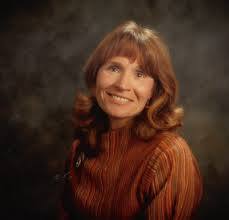
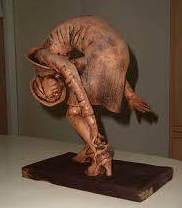
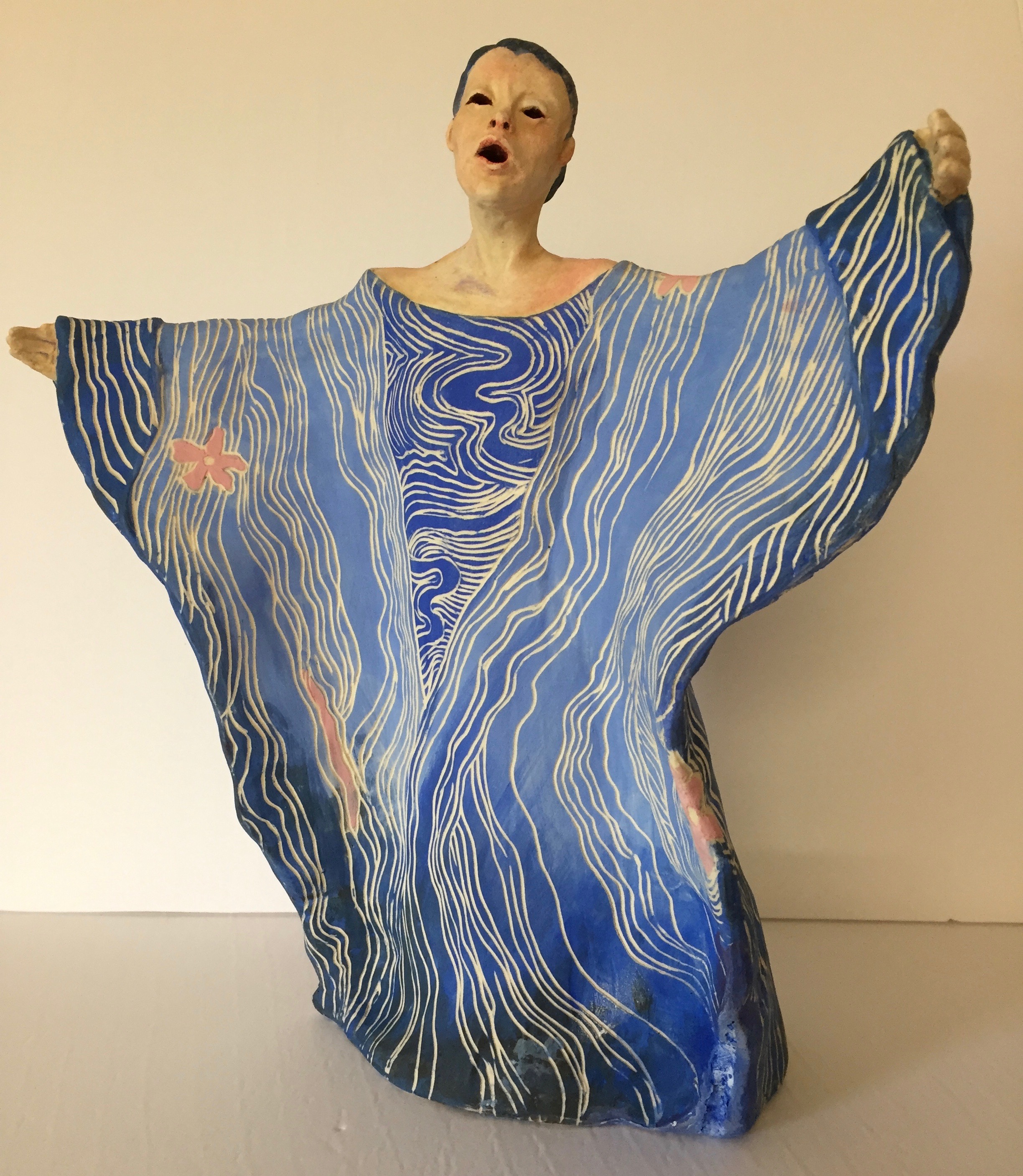
She developed a passion for sculpture, and is well-known for her humorous characters in ceramic. Her keen observation of facial expressions led her to depict droll clay sculptures of humans and animals, captured in expressive moments of action or contemplation. Her pieces were often inspired by observing the work of others in various media. Her depiction of The Chief was a favourite of hers. Her love of dance is depicted in her Dancing Woman sculpture.

She also taught pottery classes. One of her former students was delighted by Lawrence’s course: “I stumbled into pottery because a friend took a course in hand building and encouraged me to try it. I had a phenomenal teacher, Shirley Lawrence. It’s like baking, rolling dough and you’re playing with your hands making mud pies,” she jokes.

Shirley Lawrence was a member of the Ottawa Guild of Potters for many years and  contributed to the sculpture exhibitions with the National Capital Network of Sculptors. She and her husband Peter were the very generous hosts of a yearly BBQ at their property on the shore of the Ottawa River, but Shirley Lawrence also donated her energy and time in helping in the Children’s Wish Foundation, Heart Institute, Food Bank and other charities.  She remembered the hard times of her early life in England.

Shirley Lawence lived a full and adventuresome life, always active, always learning, and always meeting new friends.

https://www.pressreader.com/canada/ottawa-citizen/20160919/282394103917713

Posted in Miscellaneous | Leave a comment

Artist of the Month – Jim Lawrence, Wood Sculptor

by Sandra Marshall

Since his early years, Jim Lawrence has been enthralled by nature, camping in the wild and loving the forest and ocean near his hometown of Halifax. Rocks, plants and animals all drew him and he drew them in return.

He always enjoyed crafts -modelling clay, papier-maché, drawing and colouring, water colours, model airplanes, mecano sets, construction blocks. But he especially loved to carve wood. As a youngster, he always carried a small pen-knife and whittling branches occupied his hands and mind.

In grades 7 and 8, boys were required to take Industrial Arts. Classes were split between wood working and metal shop work, where he learned to use the basic tools and equipment for both, but was happiest working in wood.

As an adult, he began painting courses, working in oils and acrylics. Over the years he tried basic courses in clay/ceramics, soap stone/plaster carving and several wood carving courses. Again, he was happiest working in wood.

The evolution of his desire to do wood sculpture gelled only as he approached retirement about 18 years ago. That is when he began serious wood sculpture, to challenge himself and fulfill his basic desire to create.

Lawrence pursued engineering at Royal Roads Military College in Victoria and later Royal Military College in Kingston where he switched to chemistry after his third year.  He completed his studies at Dalhousie University in Halifax where he earned a PhD in Environmental Analytical Chemistry. During his time at Dal, he returned to his love of art, joining evening courses at the Nova Scotia College of Art, and later in Ottawa where he moved to pursue his scientific career. His curiosity and creativity led to a fulfilling career as a research scientist and it is this same curiosity and creativity that drives his artistic side today.. As a scientist I would always explore better ways to accomplish a task.

Lawrence considers himself lucky to have lived a year in both Amsterdam and Paris. They were wonderful opportunities to soak up the art of the masters and he visited every art museum those cities. In Amsterdam he loved the Dutch Masters and the work of van Gogh. In Paris he was drawn to the Impressionists at the Musee d’Orsay. The work of Salvadore Dali also continues to inspire him.

Like most artists, Lawrence’s creative process is driven by inspiration. The source of inspiration may be in the works of other artists, photos in print and nature itself. His broad interests sometimes lead him to create in many genres from realism,  figurative, surrealistic, abstract to expressionistic pieces.

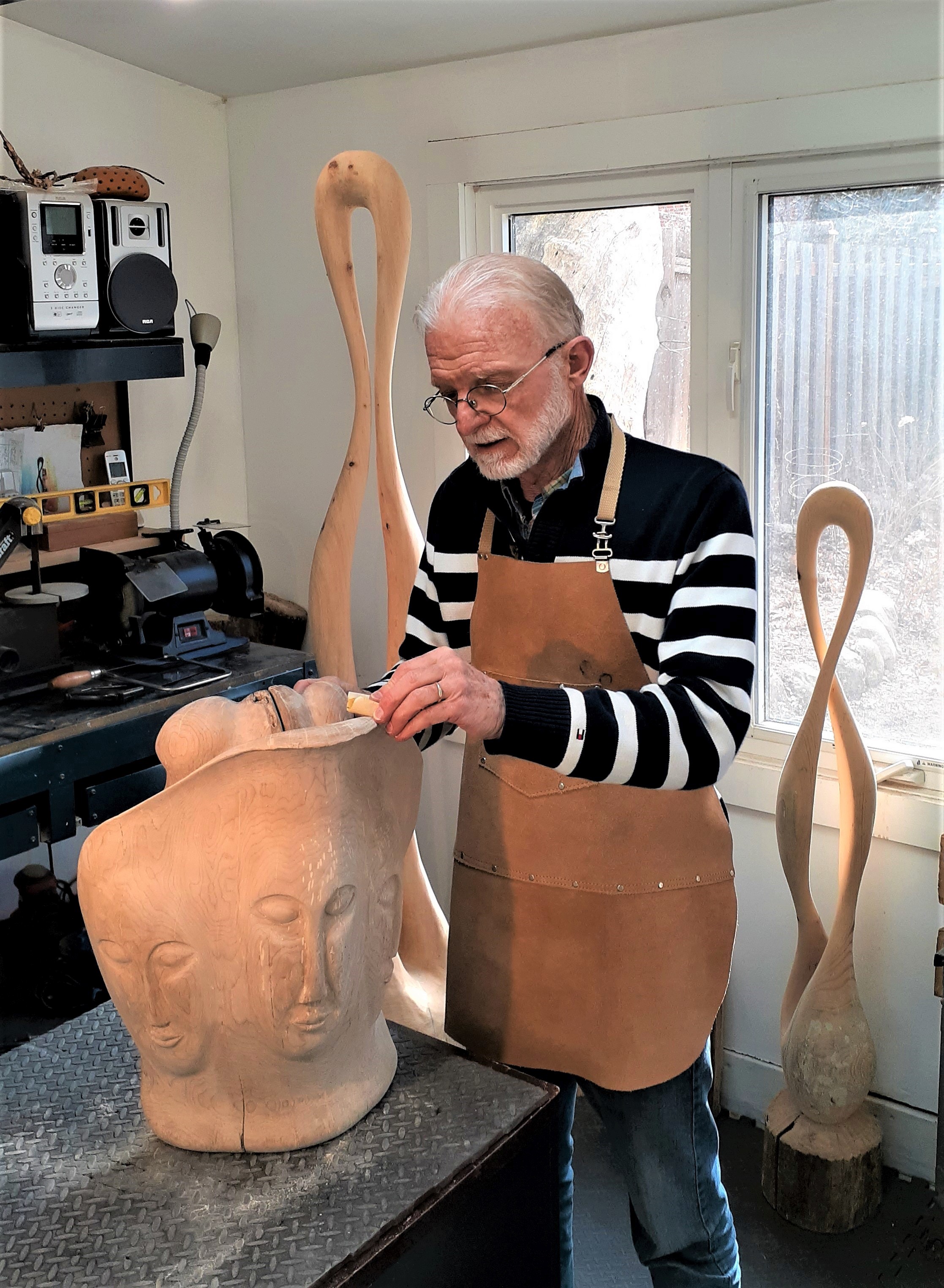
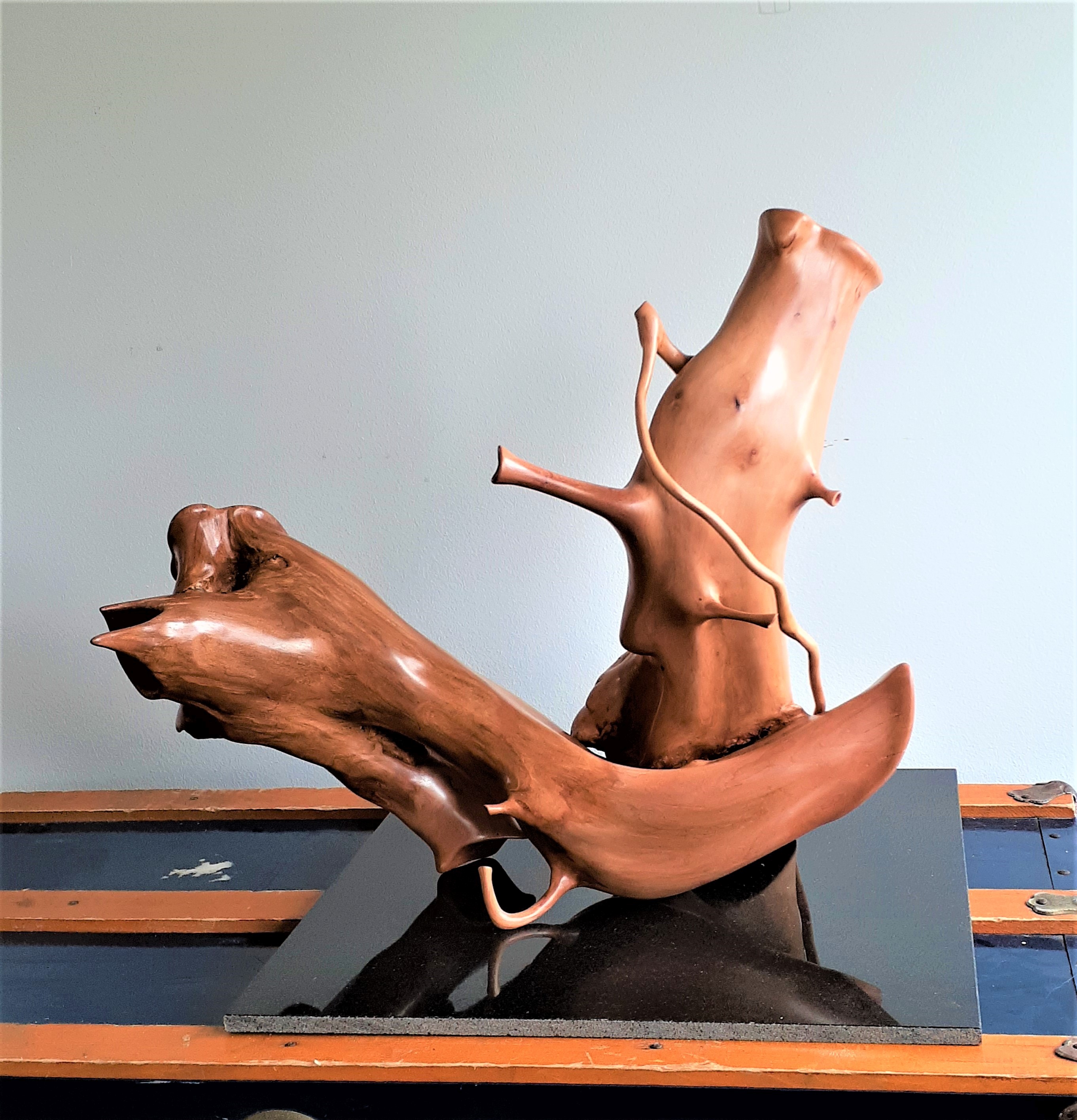
He especially enjoys carving ‘found’ wood, like suggestive tree stumps, roots and partially decayed wood,  where the spark comes directly from the wood itself.  Even when he starts a piece with a certain idea in mind, he is quite content if he ends up in a different place. Through the process, he may envision a different endpoint and makes no hesitation to change direction. As he works, the wood  changes form and texture as different wood grains appear.  That is the fun of the creative process– you often never know where you might end up!

The process is very important to him. He needs to enjoy it. So, hand carving in his studio while listening to enjoyable music is perfect for him. Time has wings. He dislikes using power tools because of safety issues, noise and dust creation, but accepts that these types of tools are necessary from time to time.

Lawrence wants to surprise and challenge the viewer with his creations. It might be a hanging baseball hat, an egg balancing on a finger or an abstract piece depicting the relationship between man and nature. Much of his work reflects the issue of human relationship with nature. His pieces pose questions about that relationship rather than offering opinions or answers.


With his curiosity and research background, Lawrence constantly experiments. He plays with different types of wood. Sizes may range from a one foot tall wall hanging to an eleven foot outdoor sculpture. He plans to integrate new materials such as metal, glass, plastic into new pieces.

Wood carving like stone carving requires some basic skills. So for a beginner, one needs to develop these to enjoy an expanded wood sculpture process. Jim Lawrence suggests that taking courses is a big help. Tools must be of good quality and chisels, gouges and knives must be kept sharp. He teaches wood carving at the Ottawa School of Art and sees that the biggest impediment to enjoyment is the use of dull tools.

Of course, his biggest recommendation is to do what you love.

https://www.jimlawrencesculptor.com

Posted in Miscellaneous | Tagged , , , , , , , , , , , , | Leave a comment

Artist of the Month – Carolyn Sandor-Weston

By Sandra Marshall

Carolyn Sandor-Weston hails from the small northern Alberta town of High Prairie. In the 60s, the town bloomed as a destination for immigrants of many nationalities, joining the First Nations residents in surrounding reserves and bringing together a unique mix of multi-ethnic languages, beliefs, and ideas. 

Being the daughter of immigrant parents and her early childhood years in High Prairie widened Carolyn’s perspectives and taught her to see the world with more empathy and feeling. Carolyn’s taste for world travel grew from this multitude of cultures and she has travelled widely before arriving with her husband and family in Ottawa in 2004. 

Sandor-Weston’s art began with poetry and prose, filling books with her writings. She went on to discover photography, wanting to capture atmosphere in the images, as do her words which create an image in one’s mind.  She entered the Alberta College of Arts in the 80s by way of her photography but was seduced by the drawing and printmaking in those fine arts departments. Here, her two-dimensional work used all variety of media to create impactful pieces. It was during this time that Carolyn realized that she was trying to express a story with her art. Today, her art is still about story telling, whether in carved stone or acrylic painting. They are reflections of how Carolyn feels and sees the world.

Awaiting Birth

During printmaking studies, Carolyn became enthused by the lithography process of etching on stone slabs. The resulting prints were not what excited her, but rather the etched stone. Her life has always included stone, from photo images to collecting stones and pebbles. She soaks up the energy they bring her. One Christmas a gift from her husband transformed her pockets-full-of-pebbles to a 25pound soapstone ready to carve. Rasps, rifflers, chisel, and mallet soon followed. Sandor-Weston’s artistic perception has guided her carving from the start, allowing the stone to tell its story and inspiring her creative energy. She sees carving as a trusting dialogue with the stone.

Her first carvings were of soft Brazilian soapstone, but she has expanded her work with harder Quebec soapstone and is experimenting with white alabaster and translucent selenite.  Bones, antlers, fur and gut, all gifts from family and friends that were collected during hikes, have found homes in Carolyn’s sculpture creations. She is now playing with bases for her sculpture and is very excited about carving bone and antler, an exploration for the coming year. 

Jubilance

Carolyn begins her carving process through feeling the stone, first softening edges with a rasp, talking to it and creating a relationship with it. She is searching for the direction that the stone pulls her. nce she has decided her direction, she uses rifflers, small hand files, and chisels to cut away. For small delicate work, Carolyn uses dental tools. Pins and epoxy may be used to set antlers or bone. Once the image starts to reveal itself, she observes the whole stone, taking time to identify the flow of the form. The movement in the finished piece is vital to her. She wants to feel that form, such as a bear’s swayback and belly. 

The free-flowing process of carving is what she loves best. ‘’Just trusting the stone and letting the stone guide you –it’s almost like breathing. Or maybe like surfing …You just go with the stone and enjoy the ride.’’ Carolyn delights in the intricacy of details, adding little surprises, like a beautiful wattle on a thick, sagging bear’s neck, or the expression on a face. They are moments of beauty where the eye can linger. ‘’Of course, the final denouement comes when I rub wax onto the stone and all its amazing colours come to life.’’ 

To achieve high polished stone requires hours of wet sanding, starting with 400 grit and slowly moving up to 3000 grit. This process can take her six to ten hours depending on the size and detail of the carving. Her love of detail requires extra time working the crevasses and grooves. After sanding, the stone is heated and then buffed with wax for a deep shine. Whether to apply a base is her final consideration when observing the finished stone. 

Head First

Carolyn’s inspirations often draw from her childhood in the north, in particular her relationships with Indigenous communities’ folklore. She respects the continuity of storytelling and lessons.

When living in Australia she felt honoured to sit in a dried riverbed with Aborigine companions listening to their stories, symbolism, and history. For many Indigenous peoples, animals represent the land and the evolution of the human story. Sandor-Weston appreciates this interconnection, often the basis of much folklore. This is why animals and humans find their way out of her stones. Employing antler, bone or fur helps to evoke the story that the earth melded in the stone and brings to life a unique connection for the viewer. She wants to further explore this connectivity that humans share with animals and the land. She respects the Indigenous community and does not want to be seen as infringing on an area that some feel she should not occupy. As she moves forward, she believes that she needs to consider this in her future work.

Carolyn Sandor-Weston is a member of the National Capital Network of Sculptors.

For beginner soapstone carvers Carolyn’s recipe is: 

Start with a small piece of Brazilian Soapstone, a couple of rifflers, one good rasp, a respirator and just play!

Carolyn Sandor-Weston Art | Facebook

@carolynsandorweston.art • Instagram photos and videos

Posted in art classes, Art Shows, Art Workshops, Artist of the Month, Canadian Stone Carving Festival, clay artists, Member Event, Member Profiles, Network Show, Online Art Gallery, sculpting workshops, Sculpture Atelier, Sculpture events, sculpture show, Stone Carver, stone carving, stone sculpture, The national capital network of sculptors | Tagged , , , , , , , , , , , | Leave a comment

Artist of the Month

As a youngster in Windsor Ontario,  Rosemary Breault-Landry had tasted the infinite possibilities of art in two and three dimensions through colour, form, gesture and tactile expression in many media  – paint, clay, canvas and paper.  Along with art, her love of cottage life and the shore of Lake Huron remains part of her psyche. 

Her art interests were sidelined when she began nursing training at the Hotel Dieu Hospital in Windsor.  At the time she took up her vocation as a  registered nurse, she met her future husband Ken at the University of Windsor. After completing their degress, the newly wed couple moved to Quebec City where he could further his studies at Université Laval , and RBL joined the nursing staff of Jeffrey Hale Hospital. Their first born arrived three years later.  Life was busy for her – working full time and eventually raising two children.

Once the kids were in grade school, the routine had been established and Rosemary was able to take art classes at local art centres. 

 Her sculpture instructor Yvonne Dorion was from Montreal’s UQUAM. Dorion opened RBL’s eyes to this new experience and encouraged her to get serious about art and enroll in a professional art school. She began with a 3-week summer courses at OCADU in Toronto to fulfill her desire for figurative art. She loved her experience there – the teachers, students and inspiration that was ever present. At age 35, after taking several part-time credits, Breault-Landry wanted to continue her studies in earnest. A family discussion ensued with her husband and two kids, who encouraged her. ‘’ Go for it Mum!’’ She realized that art expression was where she felt most at home and graduated with honours in 1992.  

 In 1996, she retired from nursing and followed her art muse. She began by teaching figurative drawing,  sculpture and mould making at the Maison des métiers d’arts in downtown Quebec. With her knowledge of clay sculpture, she was asked to demonstrate and comment on Rodin’s clay modelling techniques during the 1998 Rodin Exhibition at the Musée des Beaux-Arts in Quebec City. 

 After moving to the national capital region in the Outaouais in 2007, she has continued teaching at the Ottawa School of Art in Orleans and connecting with fellow sculptors. She has set up a studio for making her sculpture, moulds and developing patinas to finish her bronze and hydrocal pieces. Multi-tasker, she also took on the presidency of the National Capital Network of Sculptors between 2009 and 2011. She continues to participate in many sculpture exhibitions and galleries since 2000.

In her art experience she observed the work of sculptors from Michelangelo and Rodin to Giacometti and Henry Moore who have interpreted their visions of the essence of human body and spirit. Realism continues to challenge post-modernist artists.  Drawing and sculpting fellow humans allows her to explore the complexity of sculpture – the physical, emotional, intellectual and spiritual planes, and of course the effects of gravity.  Each gesture and movement in her sculpture attempts to communicate our common humanity to the observer.  She is a spontaneous teacher telling her students that ‘‘Drawing from live models is the key to comprehending form and movement as well as anatomy and expression.’’ RBL believes that success in this domain will reflect immediately in sculpture.

RBL’s bronze sculptures are made using complex technical procedures. They include ̈making rubber molds, plaster ‘mother-molds’ over the clay, and layered Aquaresin processes. Her favourite time in the process is the start of a piece, especially with a live model, when she considers the most appropriate pose for the feeling she wants to convey. Then when adding clay to the piece, observing the interesting movement of lines she considers to be great fun. She also enjoys applying the patina at the end. Remember that she started out as a painter, and loves colour.  RBL says that the passion for it keeps her young at heart, and her enthusiasm is testimony to that!

She has sculpted many public and private commissioned works which demonstrate her talents, some of which you can see on the Sculpture Ottawa Facebook pages.

You can feast on her many works by visiting her Facebook page and also her newest works at the Sculpture Expo, Pop Up Show this weekend at Lansdowne Park right next door to Goodlife Fitness. Sculpture Expo is open Thursday, October 7th to Sunday, October 10th from 10am to 6pm.

http://www.Sculptures.rbl@gmail.com

Posted in Miscellaneous | Tagged , , , , , , , , , , , , , , , , , , | Leave a comment

Artist of the Month – Uwe Foehring – Stone & Cement Artist

Uwe Foehring moved to Ottawa 25 years ago, he lived an adventurous life in international development, living and working in many countries which he found more meaningful than in private industry.  He was influenced and amazed by the new cultures that he encountered.  He saw art was a common language that is cherished in every society, regardless of riches or development. His first placement in Malawi, southern Africa, was rich in beautiful people who have integrated art in their daily lives, applying pictures and reliefs on their clay houses. Foehring says he never really learned the local language, but surely understood their art.

In his earlier years, he had a friend in Germany, Ludwig Brumme, who was a successful stone sculptor. Their conversations and interactions planted ideas and shapes in Foehring’s head that he drew upon many years later. He turned those dormant ideas into stone when he started carving about 15 years ago.  Although he had not received any formal training in the arts, he looked to courses to improve certain skills, whenever he felt the need to refine his craft.

Working in stone has a powerful emotional connection for him.  He has also tried his hand at building sculpture in cement, and more recently in ice and snow. Each of these mediums requires a different set of skills and experience, but Foehring remains focused on stone carving.

To obtain raw stone can be quite costly. When living in Sri Lanka for 3 years in various work assignments, Foehring admired beautiful Sri Lankan works made from cheap cement. Naturally, being a creative soul, he tested the skills needed to build up a work in cement, so different from carving which requires removing stone. However, cement was a good alternative for him, especially for larger sculptures.  At a Colombo art school, he found a teacher for large cement sculptures, Upali Ananda, who agreed to have the students build a Moai. Although the teacher didn’t speak any English and Foehring doesn’t speak Sinhala, they connected. Working with ones’ hands and the language of art doesn’t necessarily require words.

He often visualizes a final outcome before starting. But the longer he ruminates on that image the more it changes.  But that’s only the first step in the artistic process. Another is to adapt the image to paper or stone or a musical instrument, where again it is changed by the tools and media we use, our personality, the mood of the day and who knows what else…. This, in essence, is ‘Expressionism. An expressionist will accept all these influences as part of reality and as part of their art pieces. For Uwe Foehring, art is a language that expresses things that he cannot say verbally.  Even if the viewer does not understand the meaning right away, she will see that he has a message. He does not carve stone to show his beautiful skills. Foehring appreciates the freedom to do his own thing. He loves the crazy and comical – Marx Brothers and Freewheeling Franklin. He has no big ambitions or plans – until a new idea sparks his imagination.

When Foehring starts a stone carving, he usually has a rough idea of what he wants to create, but he says that at some point in the process his hands take over from his brain in the shaping process.  Sometimes too, news events, injustices, nature or other factors may influence the outcome. Cement sculpture requires more planning and preparation – setting up the form work using wire of different strengthsand internal fill to reduce the thickness and weight of the cement while still providing the needed structural stability. Then he needs to mix the cement ingredients and apply it to the work at the right time so that it doesn’t end up sliding onto the floor.

For anyone wanting to start on the sculpture pathway, he is clear – practice, practice, practice, as with any skill. Foehring explains that skills and art are two different things – you can be the most skilful craftsman without being an artist. Art is in the urge to bring a message across while craft is the vehicle, however imperfect, to deliver the message. No matter what the art form, music, acting, painting, the message can be the same, but the skill-set will be different.

Uwe’s final message is ‘’Be in charge of your own training – don’t let market forces or fashion or teachers tell you what is good and proper art.’’

Posted in Miscellaneous | Tagged , , , , , , , , , , , | 1 Comment

Artist of the Month – Taunyee Robbins – Sculptor of Emotions

By Sandra Marshall

Taunyee Robbins was raised by the sea in the small town of Rockport, Massachusetts. She lived in Cape Ann, an artist’s community with a long tradition of famous painters who came to represent the beautiful scenery en plein air. Her mother, Mary Robbins, was a fabulous watercolour painter and taught Taunyee how to paint when she was around ten years old. She was surrounded by an appreciation for all the arts, and continued her studies at the Massachusetts College of Art.

One summer while she was waitressing, she served a family who were speaking French, of which she had a beginner’s knowledge. Taunyee wondered if they were from France, but they responded that no, they were from Quebec. “Quebec?” she queried.  “Canada”, they replied. During her school years, Canada was shown as entirely white on the map… snow obviously, she had imagined. Obviously not! She wanted to know more, so asked a girlfriend to join her on a road trip to a place called Quebec City, and off they drove. That little road trip in the summer of 1969 introduced her to a whole new culture and a whole new country.

River

She fell in love with all of it and returned home to announce that she was going to go live in Quebec for a while. But she told her family not to worry, she would be still connected by land so she could always find her way home! 

On New Year’s Eve, of that year Taunyee became a landed immigrant in Canada and changed the whole course of her life in the blink of an eye. However, when she arrived in Quebec, she quickly realized that, her high school French skill was not going to get her far! As a new immigrant she was offered French classes with all the other immigrants. They had a terrific teacher and enjoyed that time. She became a Canadian citizen around 1980 and holds dual citizenship.

Taunyee has wanderlust -She says that she prefers the more exotic countries such as Morocco, Jordan and Egypt, as well as some of the Caribbean islands. They stir her imagination with their colors, fragrances and music! But over the years she has lived in Montreal, St. John’s, and Roddickton Newfoundland (a village on the Great Northern Peninsula) and rural Quebec.

The Journey

When she arrived in Montreal, she was fortunate to land a job with The Montreal Star newspaper. They taught her how to paste-up, design ads, and do graphic design. She continued in that field for a couple of years before she married and started a family.

In 1985, after her marriage ended, Taunyee moved to Ottawa with her three children. She also met Allen Stanish then, who would become her future husband in 1990, at a Centretown community center where aspiring jugglers and unicyclists practiced.

Taunyee re-entered the field of graphic design at Maruska Studios in Ottawa’s lively Market area. What a wonderful creative job! She designed, created colour mock-ups, cut and pasted… everything was hands on. Then in 1986 the company design work ‘transitioned’ to a square box called an Apple computer.

She missed hands-on creating and enrolled at the Ottawa School of Art in a sculpture class. Her first oeuvre was a life size bust in solid clay and she needed a forklift to move the head around. She created a plaster mold of her work and cast it in concrete. She says that she never had so much fun in her life! So, that was the beginning…  

The Messenger
The Poet

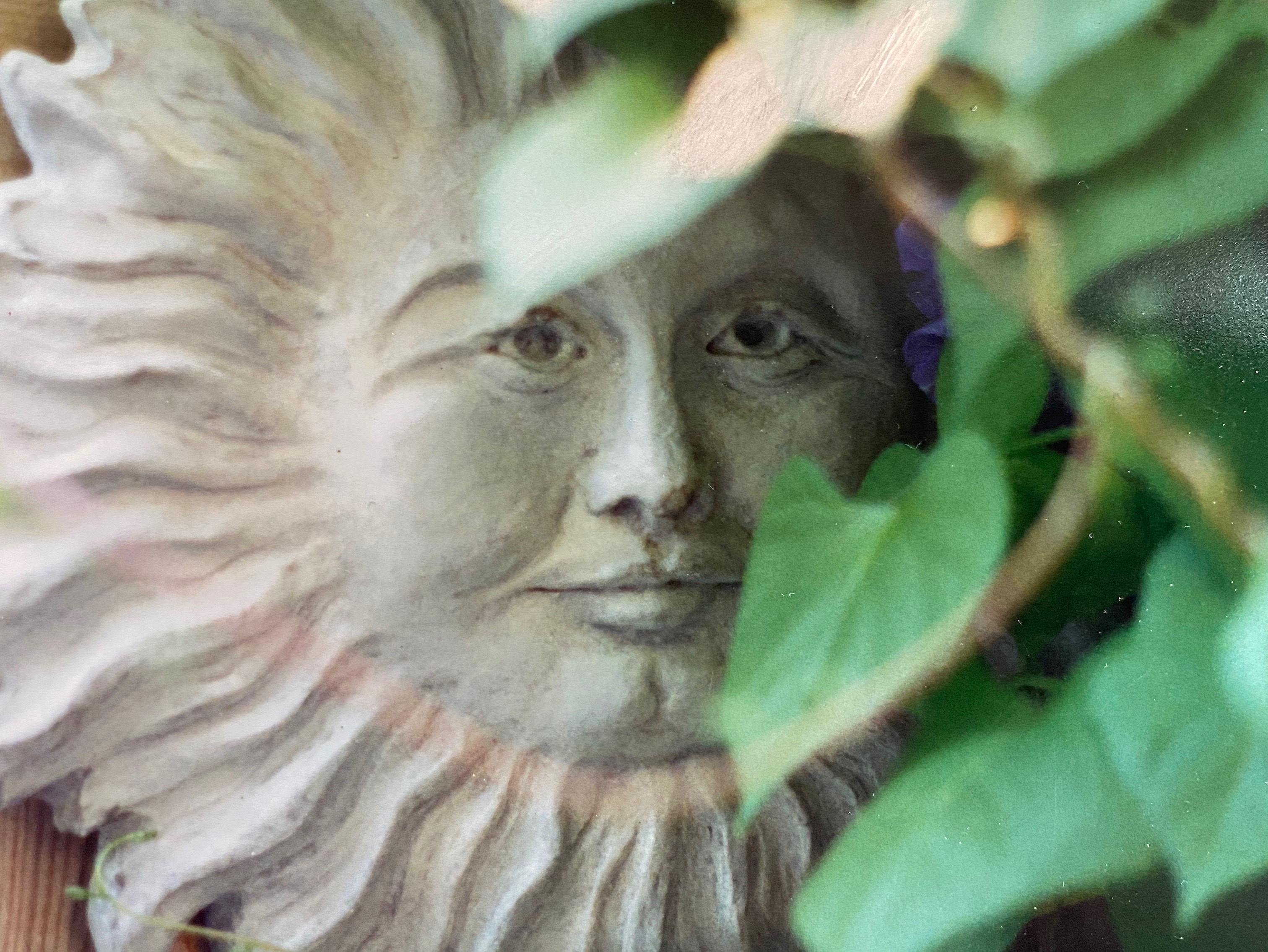
Garden sculpture had always appealed to her and she decided, with her newfound skills, to make some for herself. She designed a series of sculptures based on mythic creatures, gargoyles, lions, Greek gods, the Sun, the Windman, the Green man… Friends and family were taken by them and wanted her sculptures too. That was the start of Taunyee’s own business, Cosmoz Design (Capricious Compositions of a Peculiar Nature). Her husband Allen learned how to make molds and cast the pieces in concrete, accompanying each sculpture with a fable or story. They continued the business until 1999, when they moved back to Massachusetts to stay with her mother for a while. They were prepared to return to Canada in 2008 after her mother passed away, but then the American financial market crashed and they only made it back in 2014.Two years later Allen passed away.

The Sun

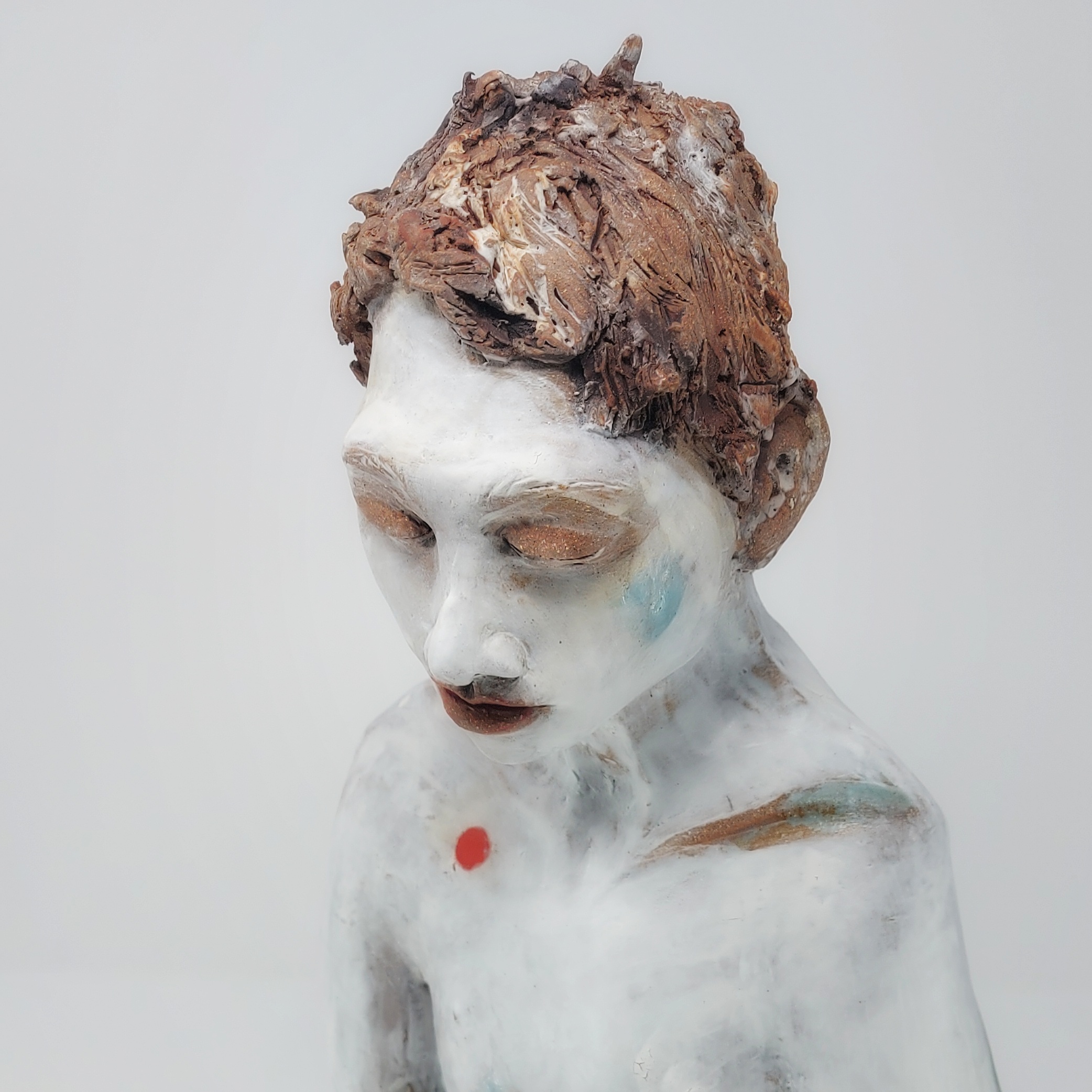
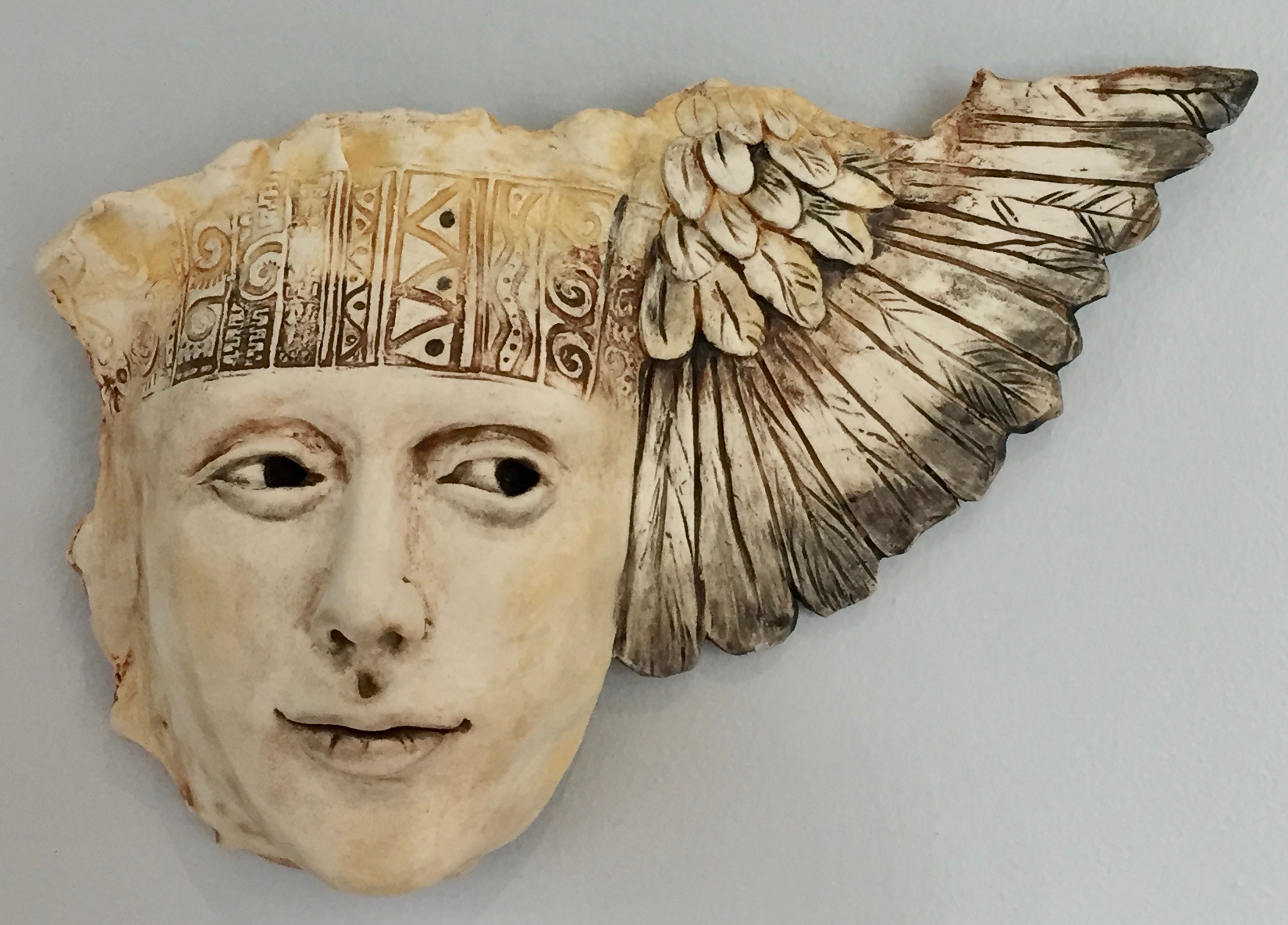
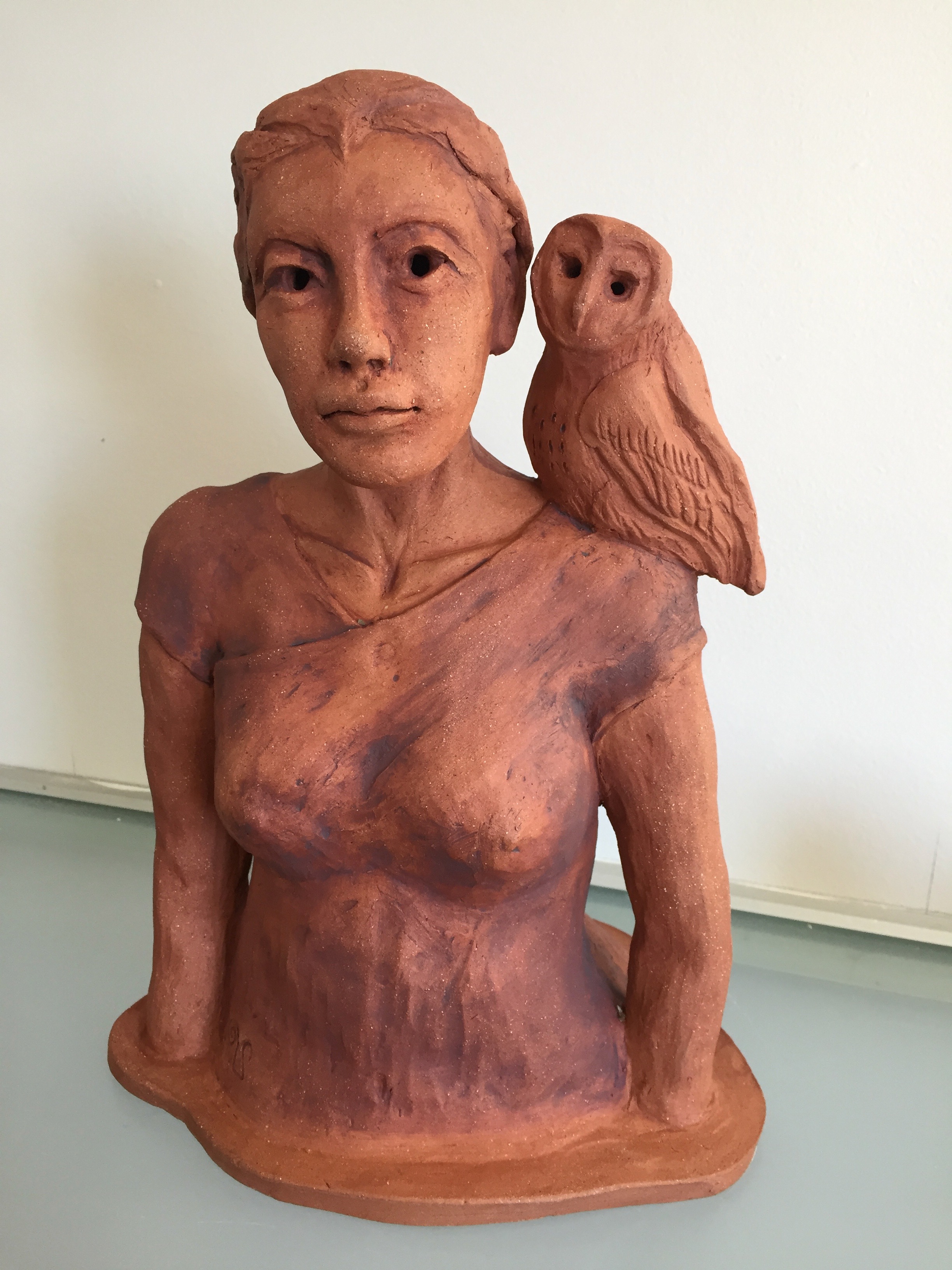
In time, Taunyee began to work in clay again, only this time in fired ceramics. It was a whole different ballgame! It was a challenge to create a hollow clay sculpture and to learn the different techniques of fabrication and firing. She discovered the engineering side of her brain! She had to keep the sculpture from blowing up in the kiln and discover the million different ways to finish the piece. She began using simple oxides and has recently been experimenting with underglazes and a scratched design technique called sgraffito. Cold finishes such as acrylic paint and even pastel were also explored. Taunyee feels that she just touched the surface of what is possible.

Over the years she has worked in every medium she could find: oil and acrylic painting, print and paper making, pastel, ink, multimedia, concrete and clay. Each experiment in these media has contributed to her creative expression.

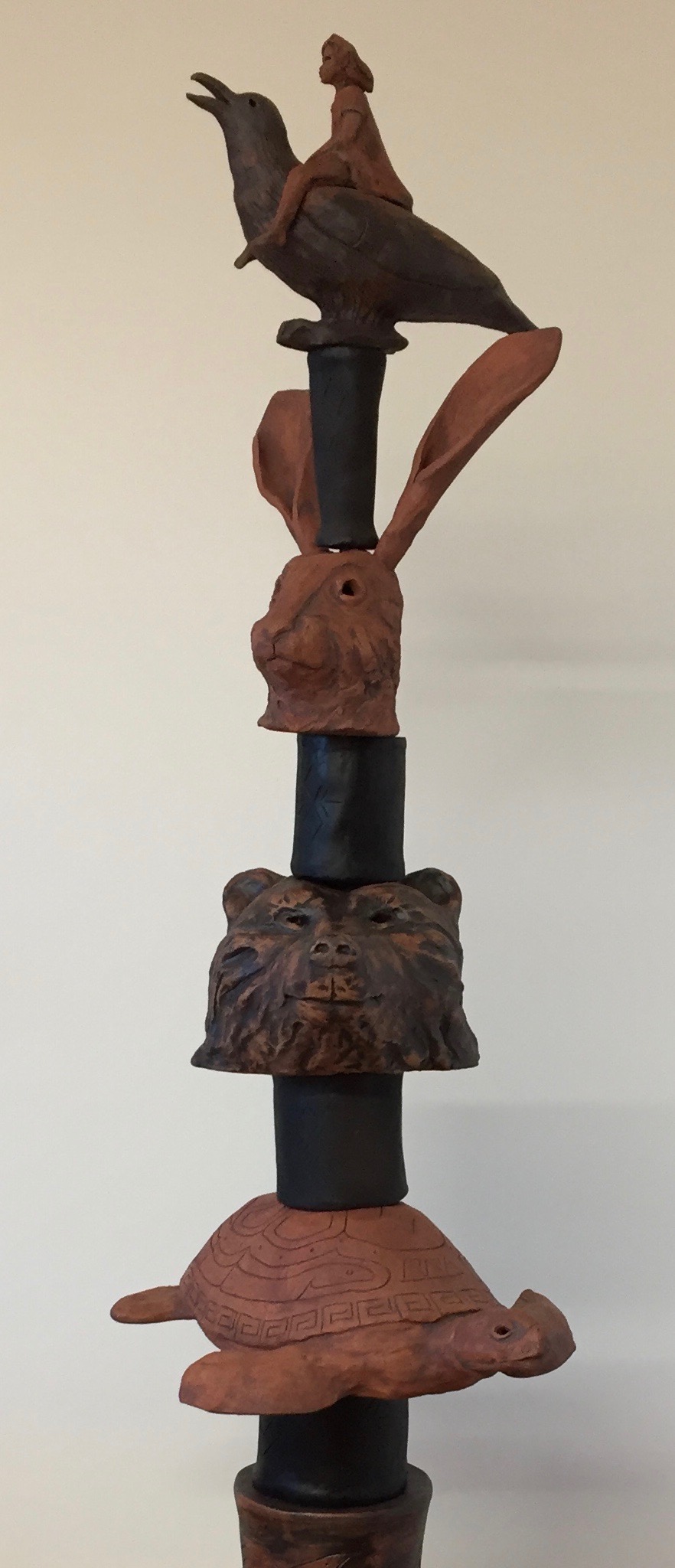
Totem

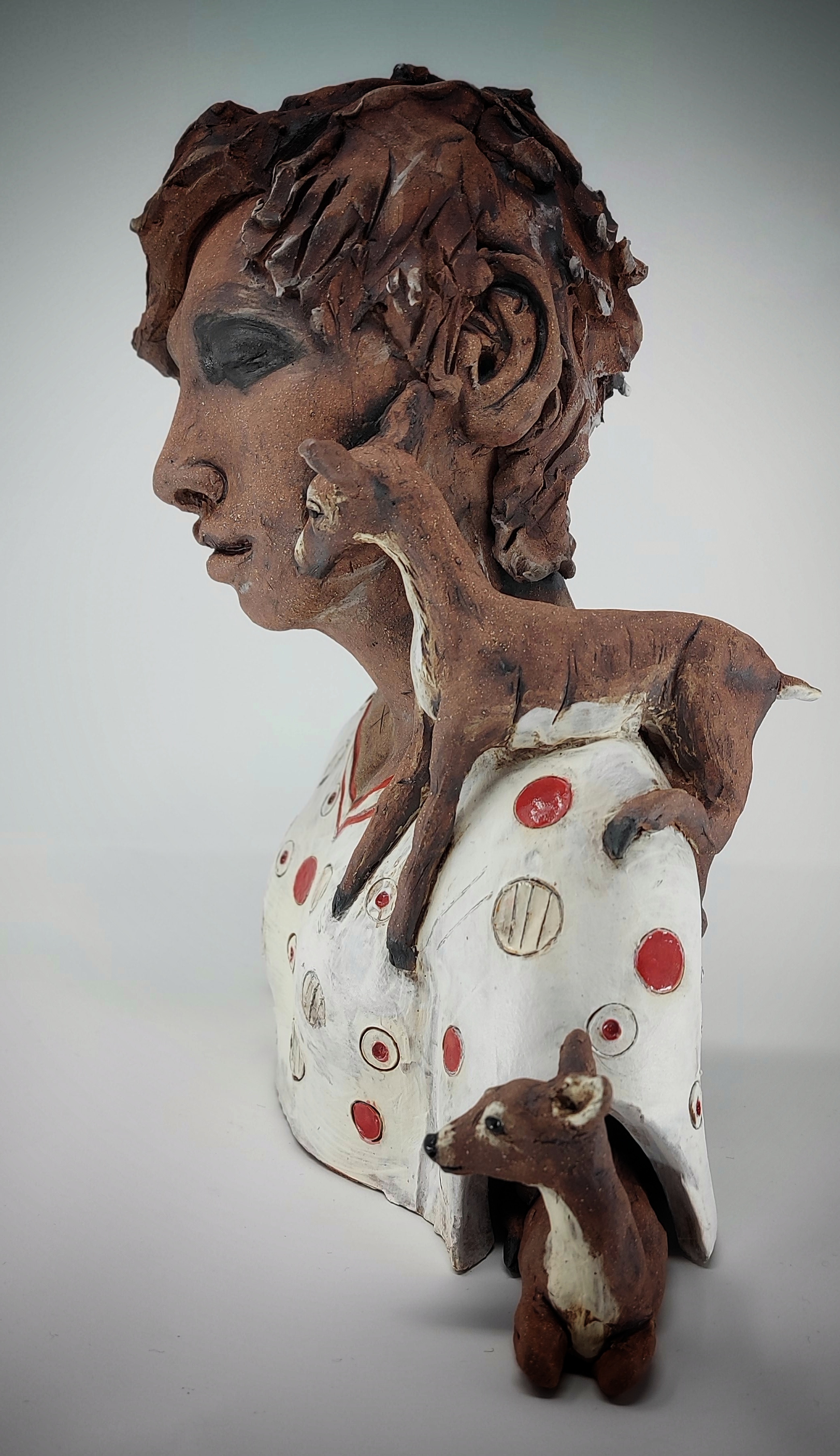
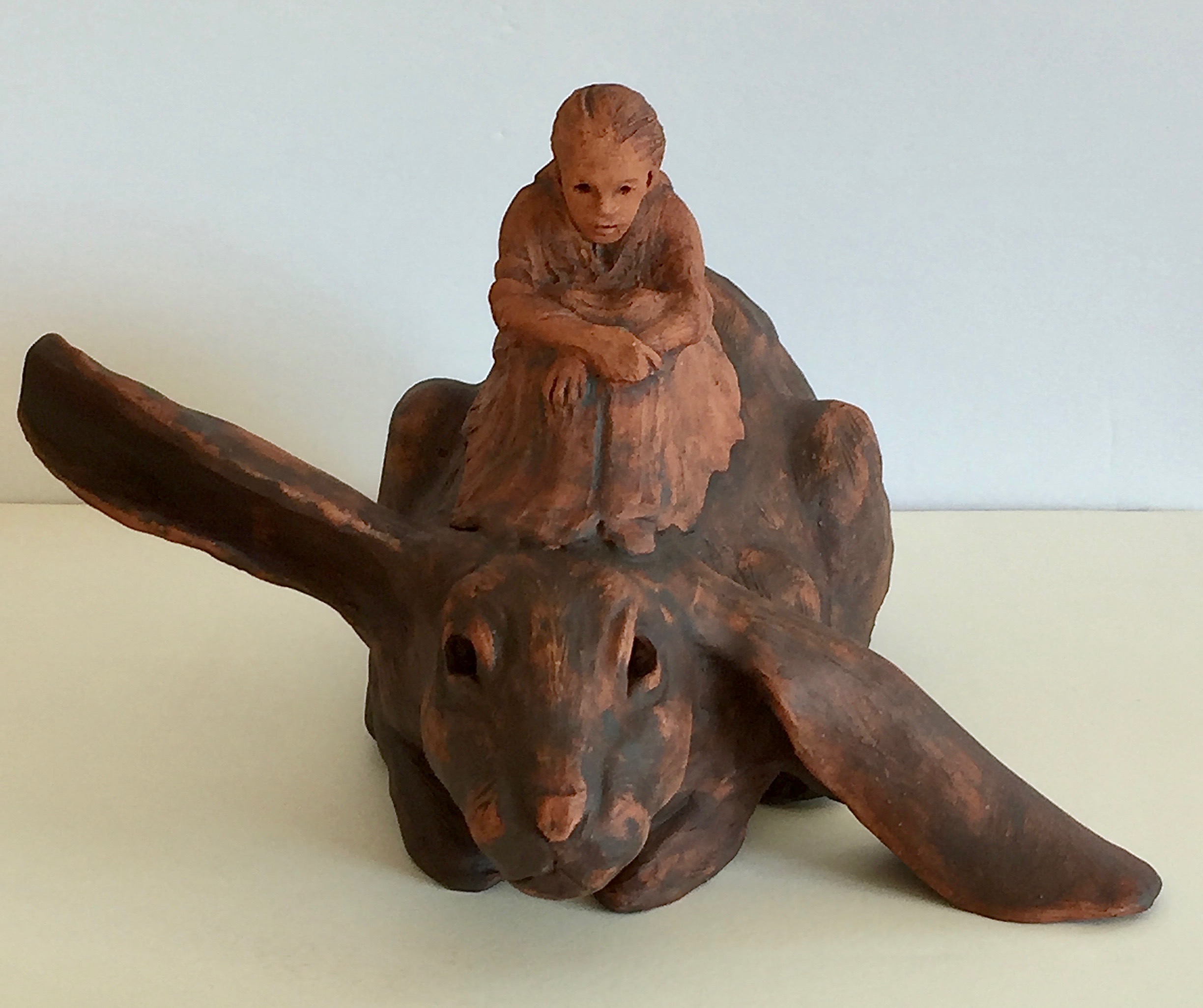
In her clay work, Taunyee is moved by an idea first, and then determines how to express that idea in clay. She makes a number of loose sketches to capture the attitude or flow of the piece. If it is a face, the expression is the most important to her.  However, a sketch doesn’t take you very far in the three dimensional world. After the idea, she must figure out how to construct it, which is the most difficult part and challenging for her. It’s called trial and error! However, once things are settled, she allows the clay to express itself. Taunyee loves how her animal and human characters take shape. They seem to emerge out of the clay by their own volition, a sign of her receptivity to new ideas.

Her only plan for her future work is to carry on exploring. She has really just begun and there is so much she wants to learn and try.

The advice she has for anyone starting out is to take some classes for the basics, and then just keep working at it.  Taunyee quotes the poet Rumi “Let yourself be silently drawn by the strange pull of what you really love. It will not lead you astray.”

Taunyee wants to touch people on an emotional level, to uplift their hearts or invite them to look deeper.  That is her special skill.

She joined the National Capital Network of Sculptors in September 2017, where she found like-minded artists and has exhibited at the annual sculpture show since then. She also sells work when people contact her from her Facebook page at http://www.facebook.com/Taunyeesculptor

Taunyee is a member of the Ottawa Guild of Potters as well and you can find her profile at www.ottawaguildofpotters.ca 

Don’t forget to check out Taunyee’s work in our Online Gallery at https://sculptureottawa.ca/online-gallery-2/

Two Wise

Posted in art classes, Art Shows, Art Workshops, Artist of the Month, ceramic, Ceramic Sculpture, clay artists, clay sculpture, Exhibition Opportunities, Member Event, Member Profiles, Miscellaneous, Network Show, Online Art Gallery, sculpting workshops, Sculpture Atelier, Sculpture events, sculpture show, workshops | Tagged , , , , , , , | Leave a comment